


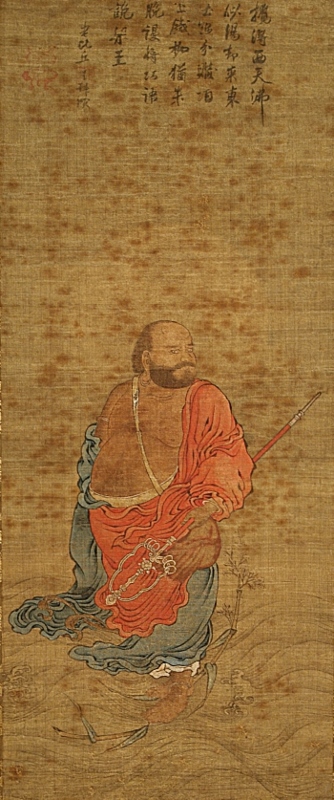
Bodhidharma on a Reed Attributed to Lu Zhongjia
- Colour on silk, 100.3×41.5cm
- Nambokucho period, 14th century
The painting “Bodhidharma on a Reed” depicts the legend of Bodhidharma, the founder of Zen Buddhism, who traveled from India to China to engage in dialogue with Emperor Wu of the Liang dynasty. However, realizing that they were unable to understand each other and that there was no opportunity, Bodhidharma rode on a reed leaf and crossed the Yangtze River to depart north. This work depicts Bodhidharma, carrying a bag slung over his shoulder and a staff in his left hand, riding on a reed on rough waves and looking back. The vivid red and blue tones of his clothing and the detailed depiction of the flowing folds in his robes are reminiscent of “The Buddha Descending from the Mountain” (Tokyo National Museum) by Liang Kai, a court painter from the Southern Song dynasty, and are thought to be an imitation of the original produced in China. The certification tag by Kano Tanyu and the box inscription for Kano Naganobu attribute this work to Lu Zhongjia, who is listed as a Yuan dynasty painter in the standard book on shelf decorations, Kundaikan Souchou Ki.
The author of the calligraphy written at the top of the work is unknown, but in a copy accompanying this work (image on the right), the seal at the end of the inscription is read as “Torin,” suggesting the possibility that the calligraphy was written by Torin Yukyu (died 1369), a Zen monk from the Northern and Southern Dynasties period. Torin was a disciple of Issann Ichinei, who traveled to the Yuan Dynasty and studied under Gekko Shoin and Soseki Bonki (1296-1370), among others, and also lived at Kenchoji and Engakuji temples, making this consistent with the date and context of his activities. A chintz case handed down from the Asano family is included.


