


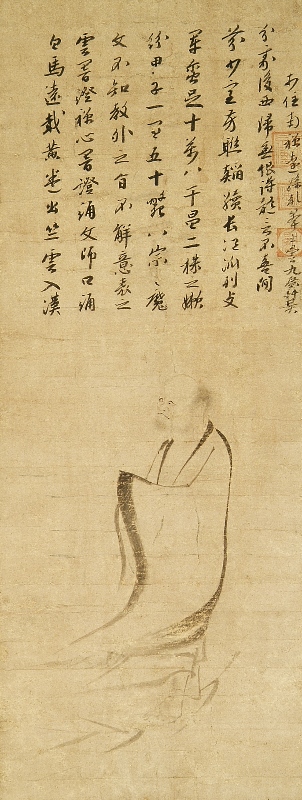
Bodhidharma on A Reed Inscription by Kempo-Shidon
- Hanging scroll, Ink on paper, 85.8×32.cm,
- Nambokucho period, 14th century
The painting “Bodhidharma on a Reed” depicts the legend of Bodhidharma, the founder of Zen Buddhism, who traveled from India to China to engage in dialogue with Emperor Wu of the Liang dynasty. However, realizing that they were unable to understand each other and that there was no opportunity, Bodhidharma rode on a reed leaf and crossed the Yangtze River to depart north.
At the top of the image is an inscription by Kempo-Shidon (1285-1361), a Zen monk who was active from the Kamakura period to the Nambokucho period. Kempo-Shidon was from Hakata in Chikuzen Province and studied under Nanzan Shiunn, the 11th abbot of Tofuku-ji Temple in Kyoto, and inherited his teachings. He served as abbot of Tofuku-ji and Nanzen-ji Temples, and during the Bunwa era (1352-55), he concurrently served as abbot of Kencho-ji and Engaku-ji Temples in Kamakura, thus being active across both the five major Zen temples of Kyoto and Kamakura. The inscription includes the phrase “former abbot Nanzen,” indicating that it was written sometime between the Kannou era (1350-52), when Kenpo left Nanzen-ji Temple, and the first year of Kouan (1361), the year of his death.

