


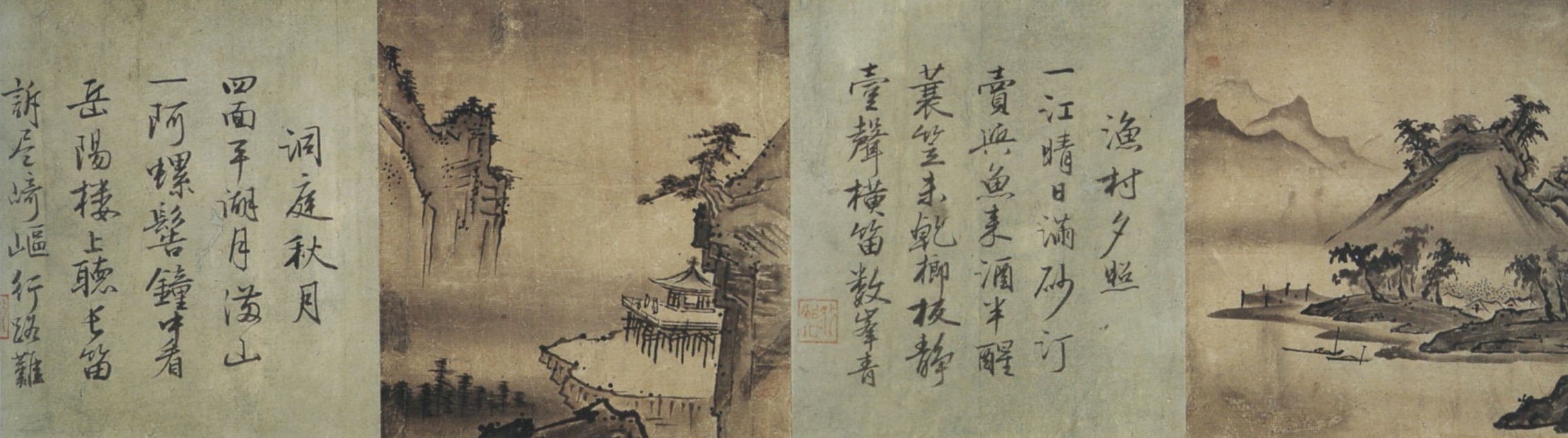
Eight Views of Xiaoxiang by Unkei Eii
- Scroll, ink on paper
- Muromachi period, 16th century
This is a painting from the Eight Views of Xiaoxiang by Sesshū-style painter Unkei Eii. The Eight Views of Xiaoxiang is a traditional Chinese painting theme, depicting eight landscapes of the Xiang River basin before it flows into Lake Dongting (Hunan Province), incorporating seasonal and meteorological changes. It also became popular as a central theme for landscape painting in Japan, and eventually eight views named after Japanese places were also selected.
Unkei Eii was a painter of the Sesshu school in the late Muromachi period. There is an article stating that he received instructions from his master Sesshu to copy Chinese paintings in 1505, around the year of Sesshu’s death, so he is thought to have been a disciple of Sesshu. His birth and death years are unknown, but based on the surviving works and documents, it is assumed that he was involved in painting around the Ouchi clan, mainly during the Tenbun era (1532-1555), and his works remain in the area around Yamaguchi Prefecture.
This work is a scroll with alternating illustrations of the Eight Views of Xiaoxiang and the corresponding inscriptions. The inscriptions are adapted from the Eight Views poem by Jakufun Gyokkan, Song – Yuan dynasty Tiantai monk who was skilled in poetry and painting. There is a red square seal reading “Eii” and a red triangular seal reading “Unkei.” At the end of the scroll is a certification dated 1681 by Kano Yasunobu, founder of the Nakahashi Kano school, and Hatakeyama Keika, an Edo period calligraphy and painting appraiser.

