


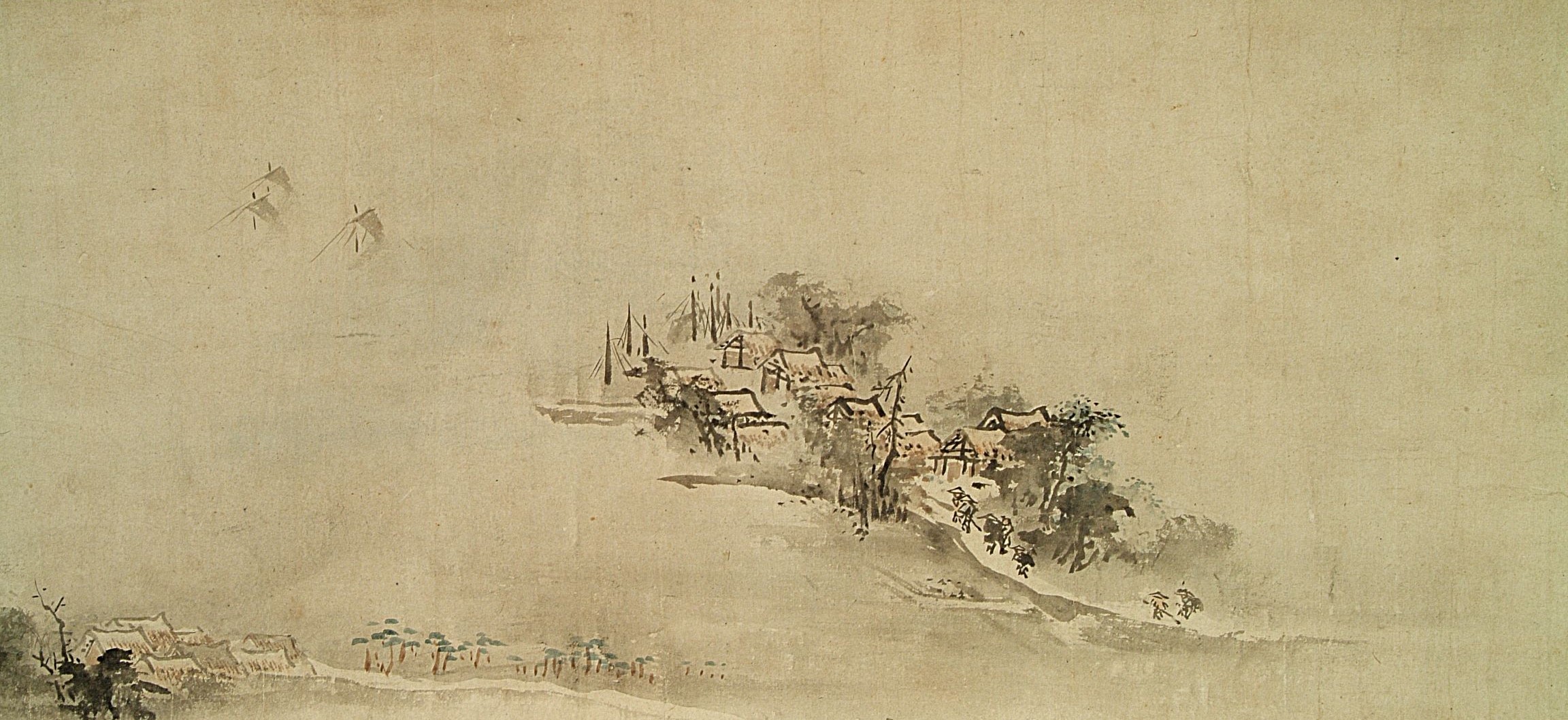
The Eight Views of Oumi by Kaiho Yusetsu
- Scroll, color and ink on paper, 27.6×333.3㎝
- Edo period, 17th century
The Eight Views of Xiaoxiang is a traditional Chinese painting theme from the Song dynasty in China, depicting eight landscapes of the Xiang River basin before it flows into Lake Dongting in Hunan Province, interweaving seasonal and meteolopgical changes.
This was likely introduced to Japan during the Kamakura period, where it gained popularity in conjunction with Yamato-e’s view of famous places. Eventually, eight landscapes named after Japanese place names were also selected, giving rise to the Eight Views of Kanazawa and Eight Views of Omi.
This painting depicts the Eight Views of Omi – the sails returning from Yabase, the evening glow at Seta, the clear storm at Awadu, the autumn moon at Ishiyama, the night rain at Karasaki, the evening bell at Mii, the granite geese at Katata, and the longing for snow at Hira with a rough sketch style making use of the gradations of ink, known as ‘Mogu (boneless) style,’ a technique in East Asian painting in which forms are rendered without ink outlines, and with a mixture of running and cursive styles.
At the end of the scroll there is an inscription that reads ‘by Kaiho Yusetsu-sai, age 73,’ a red seal of ‘Kaiho,’ and a white seal of ‘Yusetsu-sai.’
Publications
*Hibai Yoko – Selected Catalogue from the Tokiwayama Bunko, The Tokiwayama Foundation, 1967 (see commentary by Hisao Sugahara)
*Treasures of Tokiwayama Bunko Foundation – Selected Masterpieces: Calligraphy and Ink Paintings, Tokiwayama Bunko Foundation,2003 (see commentary by Noriko Takahashi)


